European Side or Asian Side of Istanbul: Where Should Foreign Buyers Buy?
- Posted in 2026-11-13
- Real Estate Blog
- By Majesty Turkey
Table of Contents
European Side or Asian Side of Istanbul: Where Should Foreign Buyers Buy?
Last updated: October 2026
Short answer: Neither side is better in general; the right side depends on your goal. The European side holds the main business districts (Levent, Maslak, Şişli), Istanbul Airport (IST) and most large new-build suburbs. The Asian side is more residential and quieter, with established neighbourhoods such as Kadıköy and Üsküdar, Sabiha Gökçen Airport (SAW) and growing districts along the Marmaray and M4 metro lines. Choose by where you will work, fly from and live, then check the specific building and neighbourhood rules.
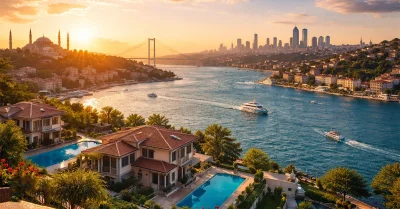
Istanbul is split by the Bosphorus into a European side (Avrupa Yakası) and an Asian side (Anadolu Yakası). The property law and the rules for foreign buyers are the same on both sides. What differs is jobs, transport, housing stock and daily life.
How the two sides differ
Business and jobs. The largest office districts are on the European side: Levent and Maslak (finance, headquarters), Şişli and Mecidiyeköy, and the historic peninsula for trade and tourism. On the Asian side, Ataşehir hosts the Istanbul Finance Centre and Ümraniye has large office clusters. Many Asian-side residents commute to Europe daily.
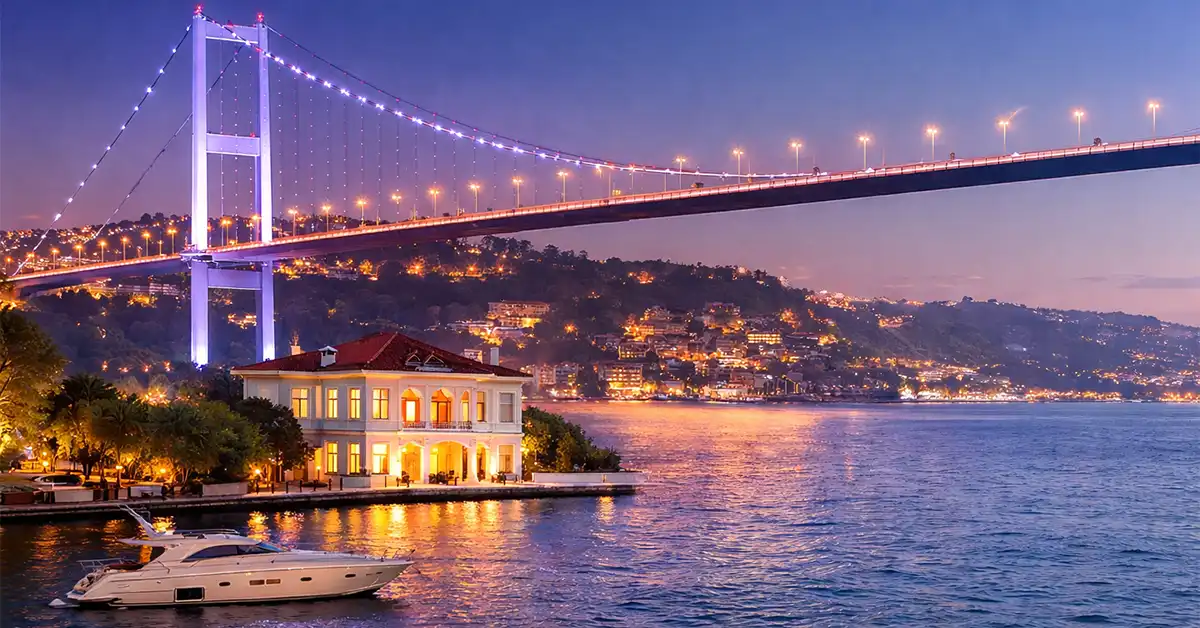
Crossing the Bosphorus. Three road bridges link the sides: the 15 July Martyrs Bridge, the Fatih Sultan Mehmet Bridge and the Yavuz Sultan Selim Bridge further north. The Eurasia Tunnel carries cars under the strait. Rush-hour traffic on them is heavy.
Rail and metro. The Marmaray rail tunnel under the Bosphorus opened on 29 October 2013, and the full 76.6 km Halkalı–Gebze line opened on 12 March 2019, linking both sides by suburban rail. Key metro lines:
- European side: M2 (Yenikapı–Hacıosman, through Şişli, Levent and Maslak), M3 (to Kayaşehir in Başakşehir), M7 (Yıldız–Mahmutbey via Mecidiyeköy and Kağıthane) and M11 (Gayrettepe–Istanbul Airport–Halkalı, completed in June 2026).
- Asian side: M4 (Kadıköy–Sabiha Gökçen Airport, extended to the airport on 2 October 2022), M5 (Üsküdar–Ümraniye and further east) and M8 (Bostancı–Parseller, towards Ümraniye).
- The Metrobus runs east–west across the 15 July Martyrs Bridge from Beylikdüzü to Söğütlüçeşme in Kadıköy.
Airports. Istanbul Airport (IST), the main international hub, is on the European side, north of the city, and connected by the M11 metro. Sabiha Gökçen Airport (SAW) is on the Asian side in Pendik, on the M4 metro.
Lifestyle. The European side is denser and busier, with most nightlife, shopping centres, international schools and hospitals concentrated around Şişli, Beşiktaş and Sarıyer. The Asian side is generally calmer and more residential, with long coastal parks in Kadıköy, Maltepe and Kartal.
New builds and established areas. Large new-build compounds are concentrated on the European side's western and northern edges (Başakşehir, Esenyurt, Beylikdüzü, Bahçeşehir) and in Kağıthane. On the Asian side, much new supply comes from urban regeneration (kentsel dönüşüm), where older buildings are replaced, especially in Kadıköy, Maltepe and Kartal, plus newer districts such as Ataşehir and Ümraniye.
Earthquake risk. The main fault segment near Istanbul runs under the Sea of Marmara, south of the city, so both sides are exposed. Ground type and building quality matter more than the side: areas on rock generally perform better than soft or filled ground, which occurs in some coastal and former stream-bed areas on both sides. Check the soil survey, the building permit date and the construction quality of the specific building. See how to check an Istanbul building before you buy.
European side districts
- Şişli: central business and residential district around Mecidiyeköy, Nişantaşı and Bomonti, on the M2 and M7 lines. See our Bomonti and Şişli area guide.
- Beşiktaş: Bosphorus shoreline, Levent business area and universities; mostly established buildings with limited new supply.
- Sarıyer: northern Bosphorus villages, forests and the Maslak business district; low-rise areas and gated communities.
- Kağıthane: a former industrial valley next to Levent, largely rebuilt with residential and office towers, on the M7 and M11 lines.
- Başakşehir: planned district with wide streets, the City Hospital and the M3 metro; much of its housing is recent.
- Beylikdüzü: western coastal district at the end of the Metrobus line, with mostly post-2000 residential blocks.
- Esenyurt: one of Istanbul's most populous districts, with a very large stock of new apartments and a big foreign resident community.
- Bahçeşehir: a planned suburb (not a separate district) split between Başakşehir and Esenyurt, with lakeside parks and low-density compounds.
Our comparison of Başakşehir and Esenyurt for citizenship buyers covers the western districts in more detail.
Asian side districts
- Kadıköy: the Asian side's cultural centre (Moda, Bağdat Avenue), with ferries, Marmaray and the M4; mostly older stock under regeneration.
- Üsküdar: historic waterfront district with a Marmaray and M5 interchange and frequent ferries to the European side.
- Ataşehir: modern district with high-rise housing and the Istanbul Finance Centre, close to the main highways.
- Ümraniye: large residential and office district on the M5 line, with many company offices and shopping centres.
- Maltepe: coastal district with a long seaside park, on the Marmaray and M4 lines.
- Kartal: coastal district undergoing large-scale regeneration, with Marmaray and the M4 interchange.
- Pendik: south-eastern district with Sabiha Gökçen Airport, the Marmaray line and high-speed train services.
For a full overview of each area, see our Istanbul areas guide.
Which side fits your goal
| Buyer goal | Usually fits better | Why |
|---|---|---|
| Work in Levent, Maslak or Şişli | European side | Short commute on M2, M7 or M11 |
| Frequent flights from IST | European side (north and west) | Direct M11 access |
| Frequent flights from SAW | Asian side (Pendik, Kartal, Maltepe) | M4 access to the airport |
| Quiet family life by the sea | Asian side | Coastal parks, settled neighbourhoods |
| Large choice of new builds | European side (west) | Most new compounds are there |
| Central, established location | Şişli, Beşiktaş or Kadıköy | Mature infrastructure, limited new supply |
| Turkish citizenship purchase | Either side | Rules are the same; the property must meet the USD 400,000 test |
| Residence permit as the main goal | Depends on the neighbourhood | Some areas are closed to new registrations |
Residence permits and closed neighbourhoods
Buying property does not by itself give the right to register in any neighbourhood. Since July 2022, the Presidency of Migration Management (Göç İdaresi Başkanlığı) has closed some neighbourhoods, and some whole districts, to new residence permit and address registrations for foreigners when the foreign population there exceeds a set share. The list is reviewed periodically and includes areas on both sides. You can usually still buy in a closed area, but may not get a short-term residence permit at that address, so check the exact neighbourhood before signing if a permit is your goal.
Frequently asked questions
Is the European side or Asian side of Istanbul better for foreign buyers?
Neither is better in general. The European side suits buyers who work in the main business districts or want a wide choice of new builds; the Asian side suits buyers who want a quieter, settled residential area.
Are the rules for foreign buyers different on the two sides?
No. Land Registry Law No. 2644, the citizenship rules and the fees are the same across Istanbul. Only local rules, such as closed neighbourhoods for residence permits, vary by area.
How do you get from the Asian side to the European side quickly?
The fastest options are the Marmaray rail tunnel, the ferries and the Metrobus. Road crossings over the three bridges and through the Eurasia Tunnel are often congested at peak hours.
Which side is safer in an earthquake?
Neither side is safe or unsafe as a whole. Risk depends mainly on the ground under the building and on how it was built, so check the specific building, not the side.
Can I get Turkish citizenship by buying on the Asian side?
Yes. Citizenship by property investment applies anywhere in Turkey if the valuation, sale price and payments each reach USD 400,000 and the other conditions are met.
Sources: Land Registry Law No. 2644; Turkish Citizenship Law No. 5901; Presidency of Migration Management (Göç İdaresi Başkanlığı) announcements on closed neighbourhoods; Istanbul Metropolitan Municipality and Metro Istanbul line information; TCDD Marmaray. This is general information and rules change; confirm the current status of a specific property and neighbourhood with a licensed lawyer and the relevant authority.
Buy with Confidence — Majesty Turkey
Buying in Istanbul is easier with a local team that does this every day.
✔️ Projects matched to your budget and goal
✔️ Support from the first viewing to the title deed
✔️ Guidance on citizenship and residence files
Message us on WhatsApp or visit our office in Bomonti, Şişli.